On Word Of Mouth Advertising

Date July 9, 2010

I just finished reading an article about an exchange between a teenager and a theatrical composer over the composer’s unwillingness to provide his work for free.

The teenager argues that the composer should provide his sheet music for free to young artists so that they have strong music to perform for their own use. She claims that by providing the sheet music for free his work will reach a young audience who can’t afford and increase his overall sales through word of mouth. The tactic as I’m sure you’ve heard is called viral marketing, peer to peer marketing, or other meaningless buzzphrases where material is released for the public to use and share in order to create peer recommendations for the good or service. I’d like to focus on this idea of viral marketing in the arts and why its not the same thing as what the teenager is talking about.

Viral marketing works by releasing a piece of content into media channels which people can share. By sharing the branded content they create interest in the product that the content is part of or refers to. For media like music this would mean releasing a single or video on the radio, Mtv, youtube, and other channels where people could view and get interested in the product. As with all advertising this kind of outreach is done based on the theory of ROI, Return On Investment. By producing the shared content the producer is expecting that they’ll gain more sales in the long term than they loose by providing the content for free.

So the teenager is correct here. One of the ways that advertising is done is through the release of free samples for the public to consume. The problem is that the teenager hasn’t specified that some content be released for use, or if she did it was the content she wanted, not the content that the composer wanted to release. As I’ve been following the file sharing debate for years the argument isn’t for the limited release of content (which has been done for years, its called the radio) its for free access to the content. Free access to content removes agency from the owner of the content. All advertising is based on that magic phrase, ROI, and by not allowing the content owner to control the release of their content they have no way of seeking that return.

Releasing a single on the radio allows the content owner to give the public a taste of the product so that they will be interested in purchasing the entire product. That’s advertising. Releasing the entire album for download and expecting that some users will enjoy the music and reward the content producer by purchasing a copy (that they already possess) is busking. You’re giving it away and asking for a dollar out of appreciation.

As much as I’ve seen the argument for the free availability of content based on the word of mouth advertising argument I haven’t seen any studies done which support it. I don’t suspect there are any as such studies are difficult to conduct and quite expensive. Its also breaking the advertising model as the content owner is no longer in control of the dissemination of their product.

I’ve seen the word of mouth argument being used across all forms of media. I’ve had it used on me recently as an online fashion magazine wanted to public my photos on their paywall protected website without payment on the promise of exposure. Conversely I’ve heard about photographers who avoid community sites like flickr and only make their work available through flash websites which prevent the download of copies of their images as they see no value in allowing the public to see their work except through their branded portfolio site.

Word of mouth advertising is heavily used and has been for a long time. I make extensive use of flickr where my work can be seen and even downloaded (abet watermarked). The key is that this is a controlled release of content of limited value which points to the real product, either a license or a print. If the composer mentioned in the article above were to freely distribute his score, there would be no reference to a greater body of work, its all out there and its now uncontrolled.

If the teenager wanted to make a compelling argument, she should have suggested that a few songs be released through his website for non-performance use.  That would give the composer the word of mouth exposure while retaining control over his catalog as a whole. Ultimately its up to the content owner to decide how they wish to advertise themselves. The argument for free content undermines the right of the content owner to make decisions, even backwards, bad decisions.

Ultimately we do live in a capitalist society and labor is done at the expectation of finding a return on that effort.  While media itself is immaterial and as the author of the article linked above states, selling digital content does not diminish a physical inventory, the creation of that content was not done without effort.  Even if nothing physical is created when working in media the process of creation did occur which requires physical equipment, time, effort, training, a location for this to occur, other actors involved in the creation, and the food, shelter, and physical comforts of all those involved.

Finding compensation for creative work is a challenge and how it is achieved has and will continue to change as media and its distribution channels evolve.  That does not mean that creators need to allow their audience to decide how they will seek that compensation.

The future of magazines?

Date March 23, 2010

Exposure Compensation wrote a short post about what he sees as the direction that commercial photography will be taking in the near future.

The writer picks out Alexx Henry who works in a strange space between photography and video.   I’ve heard it called motion graphics when I’ve worked in advertising in the past.

This is geared towards magazine features which will be available through the online version of an issue and focuses on the new(ish) tablet market which has been getting a great deal of attention with the release of Apple’s iPad.   The thought is that tablet computing will overtake the use of text readers such as the Amazon Kindle or Sony Reader as they provide the functionality of a mobile device in the same physical format for around the same price.   People don’t seem to enjoy reading magazines on their desktop or laptop computers but may change their behavior for a reader like device.

So can we expect the kind of motion graphics depicted above jumping out at us from the corner of our eye as our neighbor on the train flips through an issue of Maxim (or based on the typical content of lad magazines, busting out… emphasis on bust) on the train?

Don’t count on it.

Read the rest of this entry »

A Change of Venue

Date February 12, 2010

Hudson river from Beacon Waterfront.

In September of last year I moved out of New York City where I had been living for about 13 years.

After some personal turmoil and a financial reckoning which included four months on the dole, it was time for a change.   Beacon, NY is  a small city of about 15,000 residents sixty miles north of NYC along the Hudson River.  The city is currently best known for the Dia Art Museum which houses contemporary artwork in a former Nabisco box factory.    And Pete Seeger who actually lives up the road in Fishkill.

I moved into town without knowing a soul.  I also moved into town as fall took hold and quickly moved into winter.   Today is the 12th of February, deep in the heart of winter.   Two days ago a blizzard covered the town in nearly a foot of snow which now lays on top of the ground which has been frozen solid since December.    In the morning I’ll take the train into the city for my job and will glide down a Hudson river which is encased in a layer of ice which is groaning and cracking under the weight of the snow.

Since moving to Beacon my photography has radically changed.

After living in an incredibly dense urban area, I’ve found myself spending a great deal of time alone.  That time has been spend exploring the several parks maintained by Scenic Hudson that surround the city and breaking into decaying  factories.   The human figure has largely disappeared from my photographs.   Although I work in the city I’ve been uninterested in my former bread and butter of street photography.   Instead I’ve been deeply moved by the environment of winter in the Hudson Valley.

Perhaps its a natural change.  After thirteen years of living in the most urbanized region in the country its only natural that I would seek out the pleasure of solitude.  I suspect this will change with the arrival of spring but for now I’ve deeply enjoyed having winter to myself.

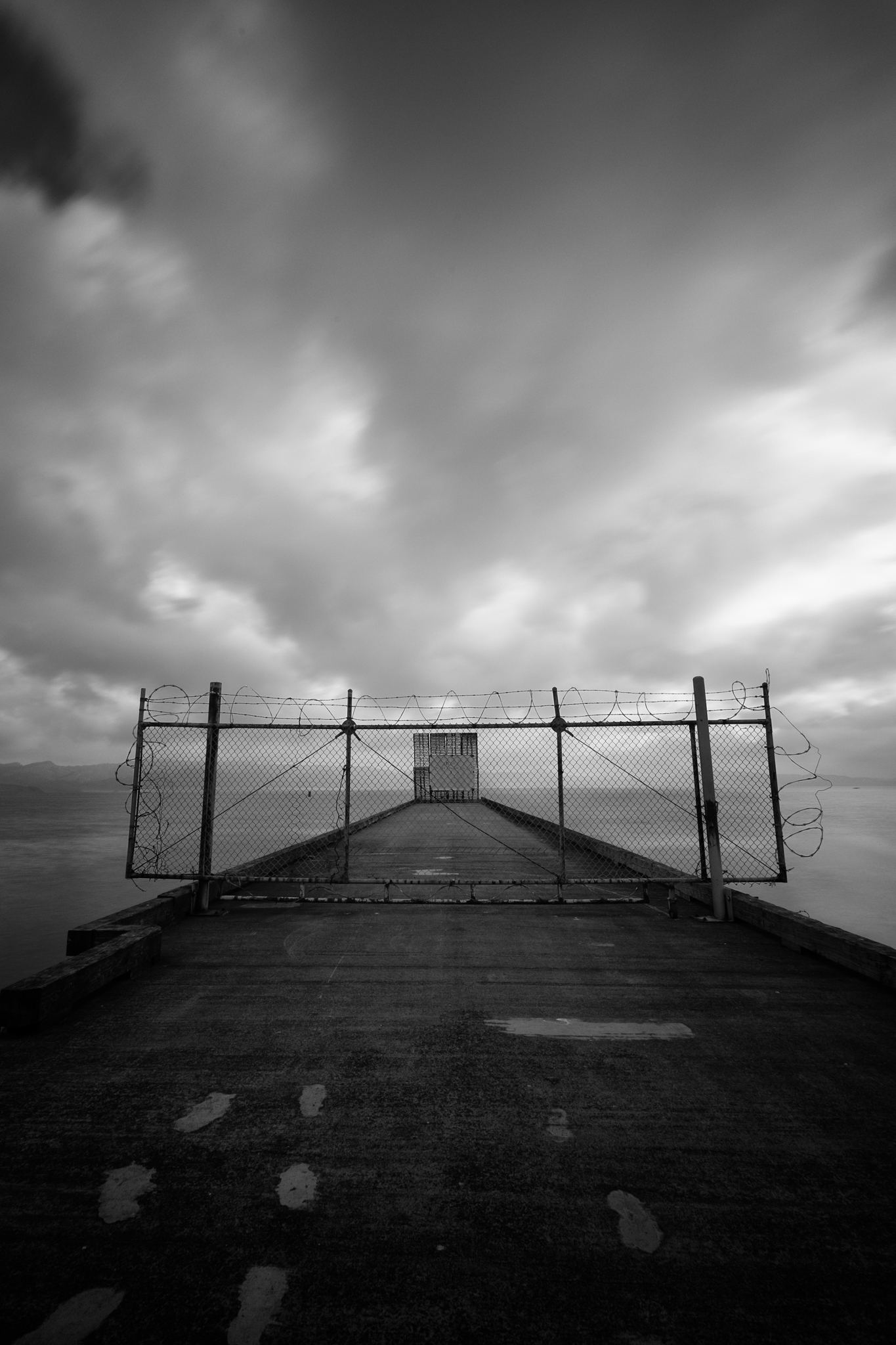
The dock extending into the Hudson River at Beacon

A New Direction

Date February 11, 2010

Muse Hotel, Midtown Manhattan

Its been several months since I’ve posted to this blog.   My original intent was to focus on my practice of film based photography as I had been almost exclusively shooting film for about 3 years at that point.   There was even a time when I was renting a darkroom and spend many hours each week slaving over an aromatic series of trays, doing prints the old fashioned way.

As of December the 27th of 2009 I purchased a Pentax K-x 12.4 megapixel camera after a late night bender involving half a bottle of reasonably priced red wine, a stack of receipts, and an excel chart.    Quite simply, I can’t afford to continue shooting film at the rate that I enjoy shooting.   At my average rate of shooting, the very reasonably priced Pentax will pay for itself in savings over film before the end of March.

This was a rational economic decision for an entirely irrational pursuit.

I think the new direction for this blog will be more focused on work in progress and my own thoughts on the practice of photography and submission to the creative impulse.

Why Bother

Date August 13, 2009

Rev. Billy demonstrates outside of AIG headquarters.  April, 2009

Rev. Billy demonstrates outside of AIG headquarters. April, 2009

This is a photograph of Rev. Billy Talen, a local activist, personality, and grassroots organizer who has earned global exile from the Starbucks company.   Here we see him with a megaphone protesting the government bailout of AIG across the street from AIG headquarters in NYC to a crowd of curious AIG employees out on their smoke break.  Other than the dozen or so fellow protesters and a few unemployed photographers such as myself this protest attracted no crowds and was only picked up by grassroots media groups such as IndyMedia which are largely ignored by the general public.

One would ask, why did he and a few other fellow travelers bother to come out on a chilly early spring day to stand outside of a building on Wall street and voice their opinion?

Why Bother?  And why did I bother taking his picture?

Read the rest of this entry »

On Apples and Oranges

Date July 12, 2009

This weekend I’m going to take a Cambo 4×5 out for a test drive.  This is the first time I’ve touched a large format camera and I’m hoping that using a polaroid back and referring to largeformatphotography.info as well as Horenstein’s celebrated B&W 102 text, Beyond Basic Black and White Photography will be enough to get me a few usable photos.

I’m excited as I can now switch back and forth between the three major formats, 35mm, medium format, and large format.  I tend to take Mr. Natural’s approach to photography in that I like to use the right tool for the job.  There are however often grey areas where the right tool is not immediately appearent.  I recently shot the NYC Pride Parade with a Hasselblad.  Most would have used a 35mm to capture a rapidly moving street parade and afterparty but my personal approach is to focus on individuals so I feel that using the medium format allows me to work in my preferred 6×6 format as I’m okay with taking my time with each shot.  My reasoning for using the Hasselblad has nothing to do with the image “quality” (although the lens has the best “look and feel” out of any lens I’ve ever used) or the ability to print BIG (if I wanted that I wouldn’t be developing with rodinal now would I?), its based on purely qualitative feelings.   The trouble is the advent of the 15+ megapixell full frame sensor has spawned the dread “quality” wars.

The quality wars ask if the new Canon or Nikon top of the line cameras can compete with medium format.  The conventional wisdom that a 35mm sized sensor could never meet or exceed the quality of a medium format sensor.  More area is more area and more area means higher quality.   Yet the numbers  thrown around by manufacturers often present a confusing series of contradictions.   If Nikon and Canon have more megapixels and reported higher dynamic range than the medium format backs offered by Leaf or PhaseOne does that mean those stuck up pro photographers are a bunch of dummies for investing $20,000 in a digital back when they can get similar peformance from a $2600 35mm body?   Are those snotty film people finally going to sit down to a steaming dish of crow?  Will those 4×5 people loose their claim to “ultimate image quality”.  And yeah, if the numbers say that 35mm is better, why hasn’t Leaf and PhaseOne started waving the white flag?     Why are we even shooting film if the quality of digital equals or surpasses it?

Read the rest of this entry »

The Times Kicks The Hornet’s Nest of Fair Use

Date June 29, 2009

New York Times columnist Sonia Zjawinski has suffered the swift and sure wrath of the internet by suggesting that photo sharing website Flickr could be used for interior decorating.  In her initial column, she suggested that you could easily search for thematic photographs on flickr, download the photos that you felt best met your decorating whim, and then print and frame them as you so desired.

This rubbed a number of flickr users the wrong way as evidenced by this entry where the power of social networks was engaged to give Zjawinski a piece of their collective minds.  The Times reacted in what I felt was a positive manner by recognizing the response to the article and then speaking to a number of legal experts on the issue of fair usage.   It engaged the audience, treated their concerns as valid, and sought the input of experts on the subject to try to come to some sort of conclusion.   The conclusion is essentially that you’re looking at an area greyer than a Scottish fog bank that’s spent the last two seasons locked in a basement abusing steroids and lifting weights but there are precedents that personal, non-commercial usage could in many cases fall under fair use provisions of copyright law.

Like many issues in law this all fun and games and idle intellectual speculation until someone gets sued and a judge (and perhaps jury) finds themselves required to listen to two lawyers lock horns, pick a winner, and then assign damages when appropriate.

I’ve discussed copyright and protection of your images online in the past so I’ll just put forward a few quick thoughts about this specific issue.   At the center of the complaint is the feeling that Zjawinski was encouraging the public to steal.  If a visitor downloads a photo from a flickr stream and prints it out for their own personal usage they’re depriving the photographer of a sale.

There are a few practical issues to consider.

Read the rest of this entry »

The Internet Runs on Tits but it Won’t Pay For Them

Date June 22, 2009

Yesterday I had my “best” day on flickr by far.  1300 views in a day when I ordinarily average somewhere below 300.  A four fold increase over the course of 24 hours.  There are views on individual photos as well as sets and my photostream in general (people who are “just browsing”).  One might inquire why I had such a magnificent day in web statistics.  The answer is simple, I gave the viewing public what they wanted.

Hooters. Tits. Boobs. Jugs. Knockers. Garbanzos. Funbags.  That which brings all the boys to the yard.

Ain't she something fellas?

Ain't she something fellas?

Read the rest of this entry »

Editing Is Everyone’s Business

Date June 17, 2009

June is a big month of photography in New York City.

Its a month dripping with interesting things to do, happenings to attend, people to observe, and fine weather to enjoy.   My personal favorite events to photograph, the Mermaid Parade in Coney Island and the Queer Pride Parade in Manhattan usually fall on the same weekend resulting in complete collapse sunday night as my sunburned flesh gives in to fatigue.   This year they fall on consecutive weekends so at least I’m spared back to back days of street high energy street shooting.

While many older and perhaps more serious photographers scorn it, I enjoy flickr a great deal.  After an event I like to see what other people took away from it.  Even people who consider themselves snappers with point and shoot cameras can often surprise themselves.  Let’s not forget the legions of avid amateurs who have high performance machines tightly gripped in their right hands and a decent amount of proficiency at Photoshop or Lightroom to boot.  Thousands of cameras will converge on the same scene and all go home with gigabytes of dirt cheap memory cards filled to the brim.  Even without a camera nearly everyone has a phone with a built in camera which are surprisingly good for snapshots in bright sunlight.

And they’ll post every single pixel of it into their photostreams.

Read the rest of this entry »

Zenitar 16mm f/2.8 Fisheye: A Few Thoughts

Date June 13, 2009

Example of dramatic use of wide angle lenses for everyday activities.

Example of dramatic use of wide angle lenses for everyday activities.

Originally I picked up the Russian made Zenitar 16mm lens for my Pentax K100D as a way to get a very wide angle lens without shelling out a great deal of money.   The K100D has a 1.5 crop factor which gets you an approximate 24mm lens.  As I refuse to buy digital only lenses my only other options were the Sigma 20mm which is a dissapointing 30mm with the crop factor or pick up Sigma’s 15mm Fisheye.  The Zenitar is available for $175 through Kiev USA while the Sigma fisheye is $750 through B&H.  There was no question which one I was going to pick up.

After reading a number of reviews I decided that the distortion would be minimized by the crop factor on the lens when used with a digital camera. I also read about a number of quality control issues which lead me to a decision not to purchase a lens through a Russian dealer.  This proved to be an excellent choice on my part as the well known infinity focus problem is not the only issue that can arise from these lenses.   A day after I placed my order a gentleman from Kiev USA called to let me know that the lens would be a few days late in arriving.  They had inspected the lens and discovered that it was missing an element which they needed to pull off another lens.   Without that element the camera would never focus.   That alone was worth the $50 price differential between ordering the lens from the US dealer.
Read the rest of this entry »